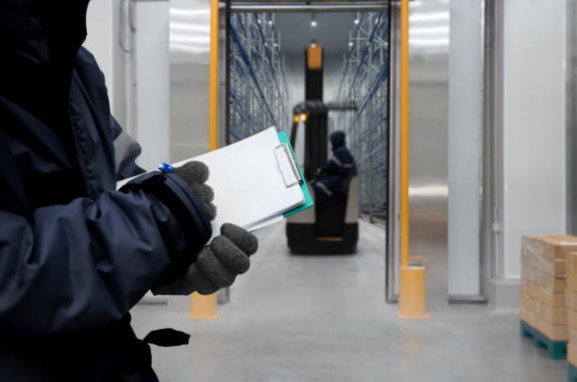
Signs Your 3PL Is Too Small for Your Business Now

The 3PL that got you here is not always the one that gets you to the next stage.
Most businesses do not outgrow their logistics provider dramatically or all at once. It happens gradually. Capacity gets tighter. Response times get slower. The things that used to work start to create friction. And because the problems are incremental rather than catastrophic, it is easy to keep tolerating them longer than you should.
By the time most businesses realise their 3PL has become a bottleneck, they have already paid the price in missed delivery windows, frustrated customers, and operational workarounds that their team has quietly built to compensate for a logistics setup that stopped fitting their business.
Here are the signs that you are there, and what the decision actually looks like.
You are regularly running out of storage capacity
The most obvious sign. If your 3PL is telling you they cannot take your next inbound shipment because they are full, or if you are managing overflow inventory in a secondary location because your primary facility cannot hold everything you need, that is a capacity problem.
The issue is not just the immediate inconvenience. Distributed inventory across multiple locations creates its own logistics overhead, separate shipping processes, separate inventory counts, separate communication chains. That overhead has a cost in time and money that compounds with every order you fulfil.
A 3PL with adequate capacity for your business should be able to accommodate your inbound volumes, your peak season requirements, and reasonable growth without you having to plan around their limitations.
Your orders are being fulfilled with errors you did not have before
Pick-and-pack error rates tend to go up when a facility is operating at or beyond its comfortable capacity. More orders, more staff under pressure, less margin for careful execution; the errors start to appear.
If your customer complaint rate has increased, if retailers are flagging packing discrepancies, or if your returns volume has grown without a corresponding change in the product itself, look at whether your 3PL's operational quality has changed as their volume has increased.
This is also a sign worth watching at peak season specifically. A 3PL that handles your volumes well in Q2 may not have the labour, the space, or the processes to maintain the same accuracy in Q4. If your error rate spikes every November and December, that pattern is telling you something.
Delivery windows are being missed more frequently
Missing a retail delivery window is not a logistics inconvenience. With major retailers like Walmart, Costco, Canadian Tire, and Sobeys, it is a compliance failure with financial consequences. Chargebacks for late deliveries, on-time in-full compliance metrics that affect your supplier standing, and, in repeated cases, the risk of losing shelf space entirely.
If your on-time delivery rate has declined and the explanation from your 3PL is capacity, labour, or carrier availability, without a clear plan to resolve the underlying issue, that is a structural problem, not a temporary one.
A 3PL that is right-sized for your business should have carrier relationships and operational capacity that make consistent on-time delivery the norm, not the goal.
You cannot get a person on the phone when something goes wrong
This one is underrated as a sign of a capacity problem at your 3PL.
When a provider is operating at the edge of their capacity, client service is often the first thing that suffers. The dedicated contact who used to respond quickly becomes harder to reach. Issues get logged but not resolved. You find yourself following up on follow-ups.
In logistics, delayed communication is delayed resolution. Every hour between a problem occurring and your 3PL beginning to address it is an hour your product is not moving, or your customer is waiting. If getting a straight answer from your logistics provider has become a project in itself, that is a problem worth taking seriously.
You have added services your 3PL cannot support
Businesses grow in more directions than just volume. You added a cross-border shipping lane and your domestic 3PL has never managed customs documentation. You started supplying a temperature-sensitive retailer and your facility does not have CFIA-certified cold storage. You need bonded warehousing for an import programme, and your provider does not hold the required designation.
Each time your business adds a service requirement that your 3PL cannot support, you either add another vendor relationship or you find a workaround. Both add cost and complexity. Over time, a logistics setup held together with multiple partial providers and manual workarounds costs more, in money, in management time, and in risk, than a single integrated provider that can handle the full scope of what your business actually does.
Your team is spending significant time managing logistics rather than your business
This is the least visible cost and usually the largest one.
When a 3PL is right-sized for your business, logistics is something that happens in the background. Your team places orders, tracks inventory, and occasionally gets an update.
When a 3PL is struggling with your volume, logistics becomes something your team actively manages, chasing updates, troubleshooting errors, coordinating between carriers and the facility, fielding retailer queries that should have been prevented.
If your operations manager, your customer service team, or you personally are spending material time on logistics issues every week, that time has a dollar value. It is also time not spent on the things that actually grow your business.
A logistics partner at the right scale removes that burden. One that is too small for your operation creates it.
Growth is creating friction instead of momentum
The clearest sign of all. When your business is growing, new accounts, new markets, higher volumes — and each growth step creates a logistics problem rather than being absorbed smoothly, the logistics setup is the constraint.
New Walmart account? Your 3PL cannot meet the compliance requirements. New cross-border lane? Your provider has never done it and needs months to set it up. Bigger inbound shipment? They need three weeks' notice, and even then it creates problems.
Growth should be the thing that works. Logistics should be the infrastructure that makes it possible. If it is the other way around, if you are turning down opportunities or slowing growth decisions because you are not sure your 3PL can handle it, that relationship has inverted.
What the transition actually looks like
Switching 3PL providers is not as disruptive as most businesses expect, particularly when the new provider has done it before and has a structured onboarding process.
The practical steps involve an inventory transfer, coordinating the movement of your stock from the current facility to the new one, updating your shipping documentation and carrier relationships, and onboarding your team to any new systems or processes. A 3PL that handles transitions regularly will manage most of this.
The timing matters. Moving during peak season is harder than moving during a quieter period. If you have identified that you need to make a change, starting the conversation with a new provider before things become critical gives you more options and a better transition.
How 3PL Links works with businesses that have outgrown their current provider
At 3PL Links, we regularly onboard businesses that have outgrown their previous logistics arrangements. Our 400,000+ sq ft CFIA-certified facility in Woodbridge, Ontario gives us the capacity to absorb growing operations without the constraints that smaller providers hit. Our services cover the full scope: warehousing, FTL and LTL freight, cross-border logistics, temperature-controlled distribution, and bonded storage, so that as your business adds requirements, you do not need to add providers.
Every client has a dedicated account contact. Not a customer service queue, but a person who knows your operation, your retailers, and your compliance requirements.
If you recognise your business in the signs above and want a straight conversation about what a transition would look like and what it would cost, reach out.
Contact 3PL Links: 🌐 www.3pllinks.com 📞 1-877-660-3362 📧 sales@3pllinks.com 📍 240 Milani Blvd, Woodbridge, Ontario